Black holes, once relegated to the realm of theoretical physics, have now become objects of intense observational scrutiny. These cosmic enigmas, with their immense gravitational pull, warp spacetime in ways that challenge our understanding of the universe. This article delves into the physics of black holes, exploring what we know, the mysteries that remain, and the cutting-edge research pushing the boundaries of our knowledge.
What is a Black Hole?
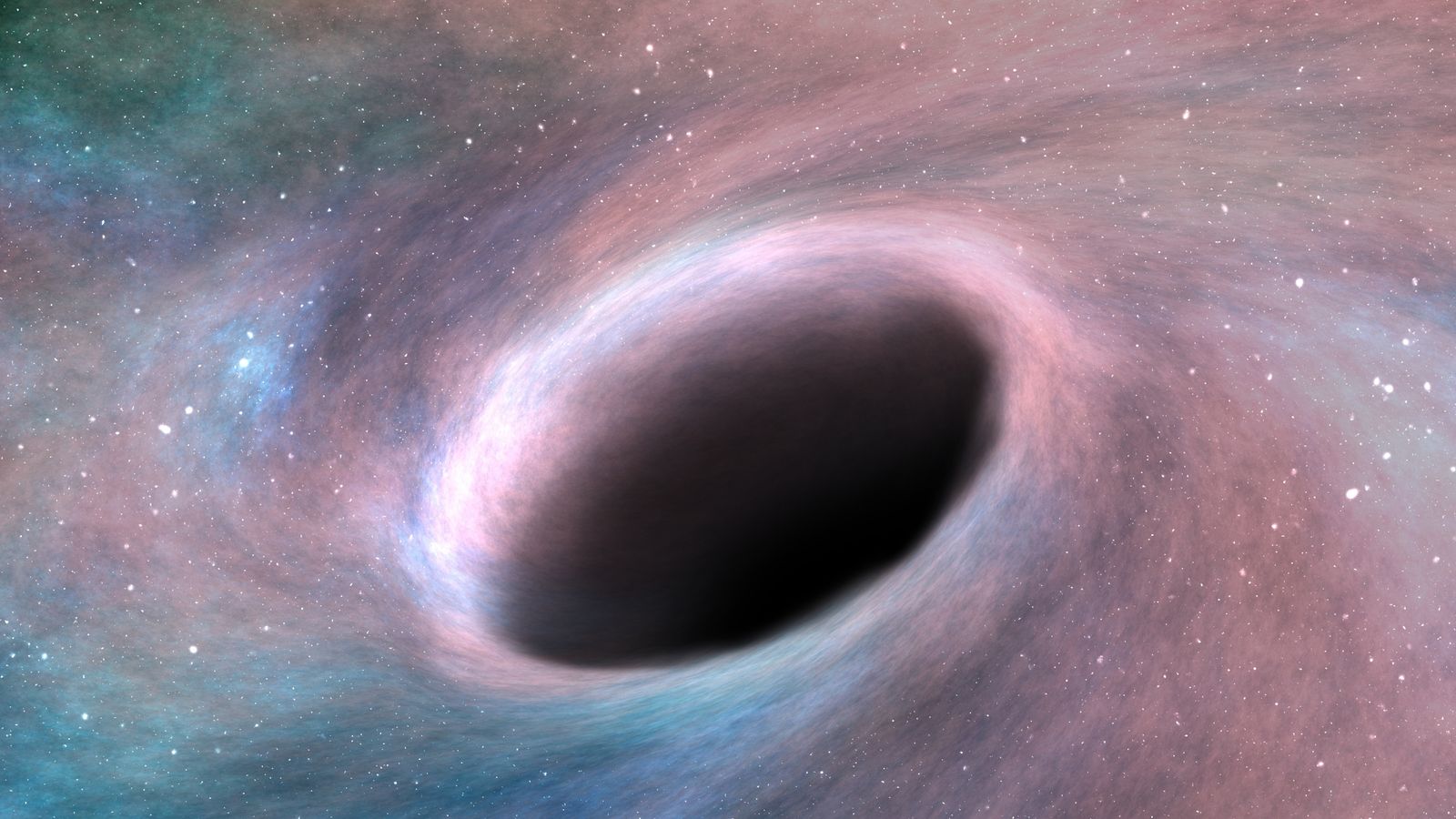
At its most basic, a black hole is a region of spacetime where gravity is so strong that nothing—no particles or even electromagnetic radiation such as light—can escape from it. The theory of general relativity predicts that a sufficiently compact mass can deform spacetime to form a black hole.
Key Components:
- Event Horizon: The boundary beyond which escape is impossible. It is not a physical surface but a point of no return.
- Singularity: The central point of a black hole, where all the matter is crushed into an infinitely small space. Here, the known laws of physics break down.
- Accretion Disk: A structure of swirling gas and dust that forms around a black hole as material is pulled in.
- Ergosphere: A region around a rotating black hole where it is impossible to remain at rest.
Formation of Black Holes
Most black holes are formed from the remnants of massive stars that have reached the end of their life cycle. When a star much larger than our Sun runs out of fuel, it can no longer support itself against its own gravity. The core collapses inward, leading to a supernova explosion. If the core is massive enough (typically more than three times the mass of the Sun), it will continue to collapse into a black hole.
There are also supermassive black holes, which reside at the centers of most galaxies. These can range from millions to billions of times the mass of the Sun. The formation of these behemoths is still an area of active research, with several theories being considered, including the direct collapse of massive gas clouds and the merging of smaller black holes.
Types of Black Holes
Black holes are categorized based on their mass:
- Stellar Black Holes: Formed from the collapse of individual stars, typically ranging from a few to tens of solar masses.
- Intermediate-Mass Black Holes (IMBHs): A rarer category, with masses between 100 and 100,000 solar masses. Their existence has been inferred but not definitively confirmed until recently.
- Supermassive Black Holes (SMBHs): Found at the centers of galaxies, with masses ranging from millions to billions of solar masses.
- Primordial Black Holes: Hypothetical black holes that may have formed in the early universe due to density fluctuations. Their existence is purely theoretical.
The Physics of Black Holes: Key Concepts
- General Relativity: Einstein’s theory of general relativity is the foundation for our understanding of black holes. It describes gravity as the curvature of spacetime caused by mass and energy. Black holes represent the ultimate manifestation of this curvature.
- Hawking Radiation: A theoretical process by which black holes emit thermal radiation due to quantum effects near the event horizon. This radiation causes black holes to slowly lose mass over time, eventually evaporating.
- Spaghettification: The stretching and compression of objects as they approach a black hole due to the extreme tidal forces.
- Frame-Dragging: The effect by which a rotating black hole drags spacetime around with it, affecting the motion of objects nearby.
Observational Evidence
For many years, black holes were theoretical constructs. However, recent advancements in observational astronomy have provided compelling evidence for their existence.
- Gravitational Waves: The detection of gravitational waves by the Laser Interferometer Gravitational-Wave Observatory (LIGO) and Virgo collaborations has provided direct evidence of black hole mergers. These mergers release immense amounts of energy in the form of gravitational waves, which can be detected on Earth.
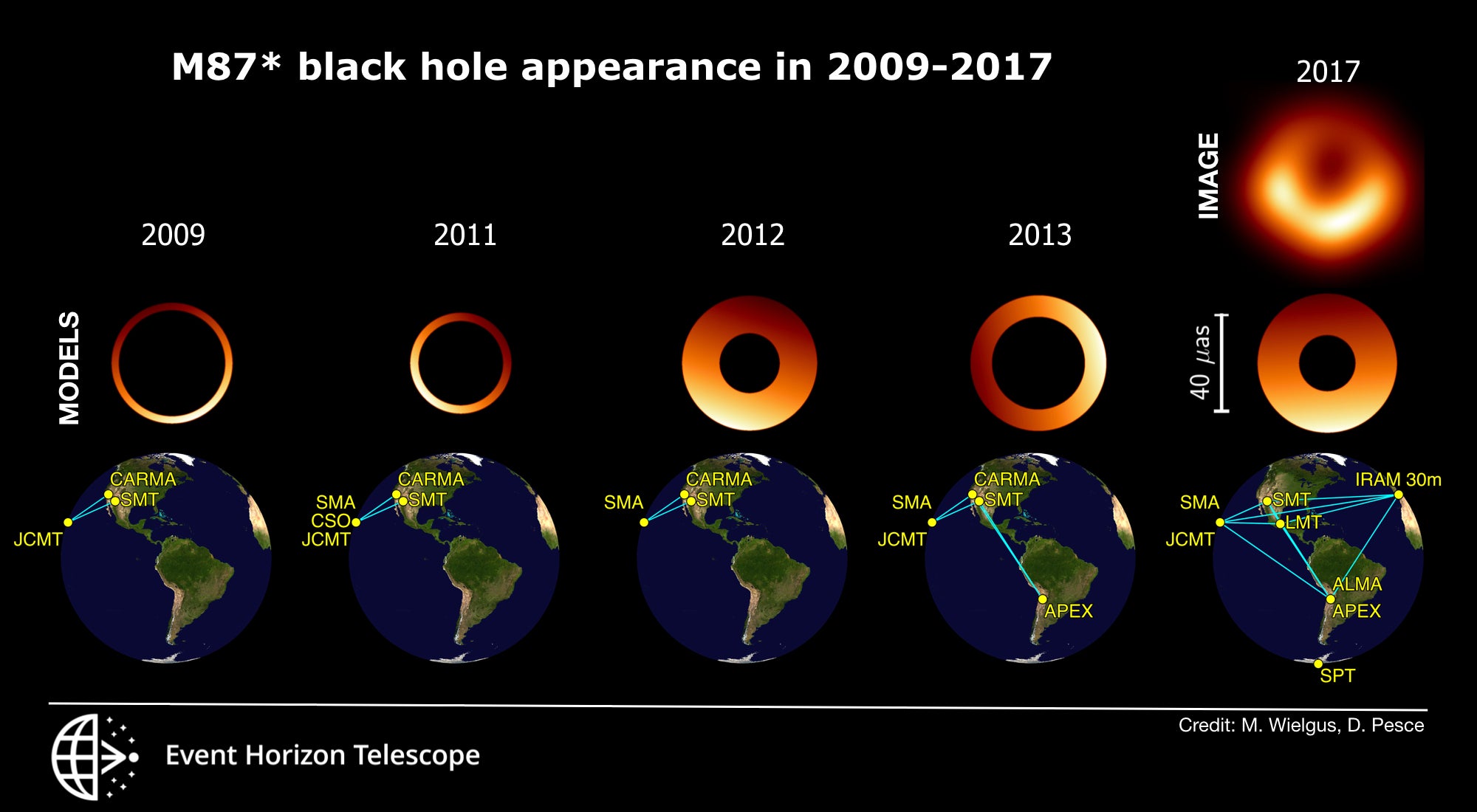
- Event Horizon Telescope (EHT): The EHT collaboration captured the first direct image of a black hole’s shadow at the center of the galaxy M87. This groundbreaking achievement provided visual confirmation of the existence of event horizons and the predictions of general relativity.
- Stellar Orbits: Observations of stars orbiting the supermassive black hole at the center of our Milky Way galaxy have provided precise measurements of its mass and location.
- X-ray Emission: Accretion disks around black holes can become extremely hot, emitting intense X-rays that can be detected by space-based telescopes.
Mysteries and Open Questions
Despite the significant progress in our understanding of black holes, many mysteries remain:
- The Information Paradox: According to quantum mechanics, information cannot be destroyed. However, Hawking radiation appears to violate this principle, as it is thermal and does not seem to carry information about the matter that fell into the black hole.
- The Singularity: The singularity at the center of a black hole is a point where the laws of physics break down. We need a theory of quantum gravity to understand what happens at this point.
- The Formation of Supermassive Black Holes: The origin of supermassive black holes is still a puzzle. How did these behemoths grow so large so quickly in the early universe?
- The Nature of Dark Matter: Some theories propose that primordial black holes could make up a significant portion of dark matter, but this remains speculative.
- Black Hole Interiors: What lies beyond the event horizon? Is it possible to travel through a black hole into another universe, as some theories suggest?
Future Research
The study of black holes is a vibrant and rapidly evolving field. Future research will focus on:
- Improving Gravitational Wave Detectors: Upgrading LIGO and Virgo and building new gravitational wave observatories will allow us to detect more black hole mergers and probe the properties of black holes with greater precision.
- Next-Generation Telescopes: Building larger and more powerful telescopes, both on the ground and in space, will enable us to observe black holes in greater detail and study their environments.
- Theoretical Advances: Developing a theory of quantum gravity is essential for understanding the singularity and resolving the information paradox.
- Multi-Messenger Astronomy: Combining observations from different types of telescopes (e.g., radio, optical, X-ray, gravitational wave) will provide a more complete picture of black holes and their interactions with their surroundings.
Conclusion
Black holes are among the most fascinating and mysterious objects in the universe. They challenge our understanding of gravity, spacetime, and the fundamental laws of physics. While significant progress has been made in recent years, many questions remain unanswered. The ongoing research and future observations promise to reveal even more about these cosmic enigmas, pushing the boundaries of our knowledge and opening new horizons in astrophysics and cosmology.


Comments
Post a Comment