For centuries, blindness has been a condition that profoundly impacts an individual’s quality of life, limiting their independence, mobility, and access to the world around them. However, advances in medical technology have brought forth a beacon of hope in the form of bionic eyes, also known as visual prostheses. These innovative devices offer the potential to restore partial vision to individuals with certain types of vision loss, opening up new possibilities and improving their overall well-being.
Understanding Vision Loss and the Need for Bionic Eyes
Vision loss can occur due to a variety of factors, including genetic conditions, age-related macular degeneration (AMD), glaucoma, diabetic retinopathy, and trauma. While some causes of vision loss can be treated or managed with conventional methods such as glasses, medication, or surgery, others are irreversible.
Bionic eyes are designed to address vision loss caused by damage to the retina, the light-sensitive tissue at the back of the eye that converts light into electrical signals sent to the brain. In conditions like retinitis pigmentosa (RP) and advanced AMD, the photoreceptor cells in the retina degenerate, disrupting the transmission of visual information. Bionic eyes bypass these damaged cells and directly stimulate the remaining retinal cells or the optic nerve, allowing individuals to perceive light and shapes.
How Bionic Eyes Work: A Technological Marvel
Bionic eyes are complex devices that typically consist of several components working together to restore a sense of vision:
External Camera: A miniature camera, often mounted on eyeglasses, captures images of the surrounding environment.
Video Processing Unit: A small computer processes the images captured by the camera, enhancing contrast and converting them into electrical signals.
Transmitter: The processed signals are transmitted wirelessly to an implanted receiver in the eye.
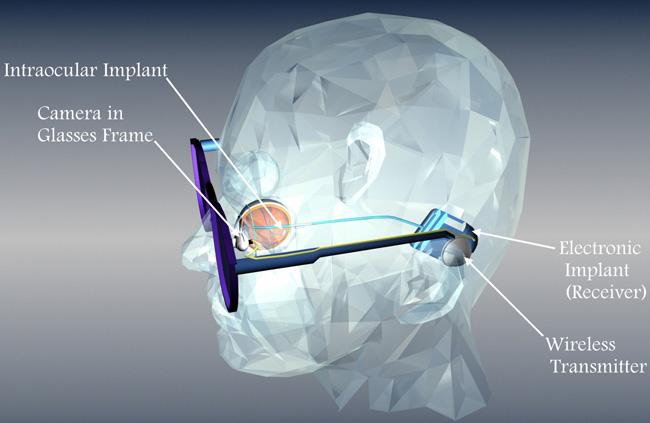
Retinal Implant: A microchip containing an array of electrodes is implanted onto or beneath the retina. These electrodes stimulate the remaining retinal cells or the optic nerve.

Stimulation of Retinal Cells or Optic Nerve: The electrical signals from the implant stimulate the targeted cells, which then transmit the information to the brain.
Visual Cortex Interpretation: The brain interprets the electrical signals as patterns of light and dark, allowing the individual to perceive basic shapes, movement, and contrast.
Types of Bionic Eyes: Different Approaches to Vision Restoration
Several types of bionic eyes have been developed, each with its own unique approach to restoring vision:
Epiretinal Implants: These implants are placed on the surface of the retina, stimulating the ganglion cells, which are the last layer of cells in the retina before the optic nerve. The Argus II Retinal Prosthesis System is an example of an epiretinal implant.
Subretinal Implants: Subretinal implants are placed beneath the retina, in the space where the photoreceptor cells used to be. These implants aim to stimulate the remaining retinal cells more directly.
Suprachoroidal Implants: These implants are placed in the suprachoroidal space, between the choroid and the sclera. They stimulate the retina from behind.
Optic Nerve Implants: In cases where the retina is severely damaged, optic nerve implants can be used to stimulate the optic nerve directly, bypassing the retina altogether.
The Argus II: A Pioneering Bionic Eye System
The Argus II Retinal Prosthesis System, developed by Second Sight Medical Products, was one of the first bionic eye systems to receive regulatory approval. It is an epiretinal implant designed for individuals with advanced RP.
The Argus II system consists of an external camera mounted on eyeglasses, a video processing unit, and a retinal implant with 60 electrodes. The camera captures images, which are processed and transmitted to the implant. The implant then stimulates the ganglion cells in the retina, allowing individuals to perceive patterns of light and dark.
Clinical trials of the Argus II have shown that it can improve visual function in individuals with RP, enabling them to perform tasks such as locating objects, following lines, and detecting movement. While the vision provided by the Argus II is limited, it can significantly enhance an individual’s independence and quality of life.
The Promise and Limitations of Bionic Eyes
Bionic eyes hold tremendous promise for restoring vision to individuals with certain types of vision loss. They can provide a sense of independence, improve mobility, and enhance overall quality of life. However, it is important to acknowledge the limitations of current bionic eye technology:
Limited Visual Acuity: Bionic eyes do not restore normal vision. The visual acuity achieved with current devices is limited, typically allowing individuals to perceive basic shapes, movement, and contrast.
Surgical Risks: The implantation of a bionic eye involves surgery, which carries inherent risks such as infection, bleeding, and retinal detachment.
Cost: Bionic eye systems are expensive, and the cost can be a barrier to access for many individuals.
Rehabilitation: After implantation, individuals require extensive rehabilitation to learn how to interpret the visual information provided by the bionic eye.
Future Directions in Bionic Eye Technology
Research and development in the field of bionic eyes are ongoing, with the goal of improving visual acuity, expanding the range of treatable conditions, and reducing the invasiveness of the technology. Some promising areas of research include:
Higher-Resolution Implants: Developing implants with a greater number of electrodes to provide more detailed visual information.
Advanced Image Processing: Improving the algorithms used to process images captured by the camera to enhance contrast and clarity.
Wireless Power and Data Transmission: Developing fully wireless systems to eliminate the need for external cables and improve comfort.
Gene Therapy and Stem Cell Therapy: Combining bionic eye technology with gene therapy or stem cell therapy to regenerate damaged retinal cells.
Artificial Intelligence (AI) Integration: Using AI to enhance the processing of visual information and provide more meaningful visual cues to the user.
Ethical Considerations
As with any emerging technology, the development and use of bionic eyes raise ethical considerations. These include:
Informed Consent: Ensuring that individuals considering bionic eye implantation fully understand the potential benefits and risks.
Access and Equity: Addressing the high cost of bionic eye systems to ensure equitable access for all individuals who could benefit.
Psychological Impact: Providing support and counseling to individuals adapting to life with a bionic eye, as the restored vision may not meet their expectations.
Privacy and Security: Protecting the privacy and security of data collected by the external camera and processing unit.
Conclusion
Bionic eyes represent a remarkable achievement in medical technology, offering hope to individuals with vision loss caused by retinal damage. While current bionic eye systems have limitations, they can significantly improve an individual’s independence and quality of life. Ongoing research and development efforts are focused on improving visual acuity, expanding the range of treatable conditions, and making the technology more accessible. As bionic eye technology continues to advance, it holds the potential to transform the lives of millions of people around the world, restoring their connection to the visual world and opening up new possibilities.


Comments
Post a Comment